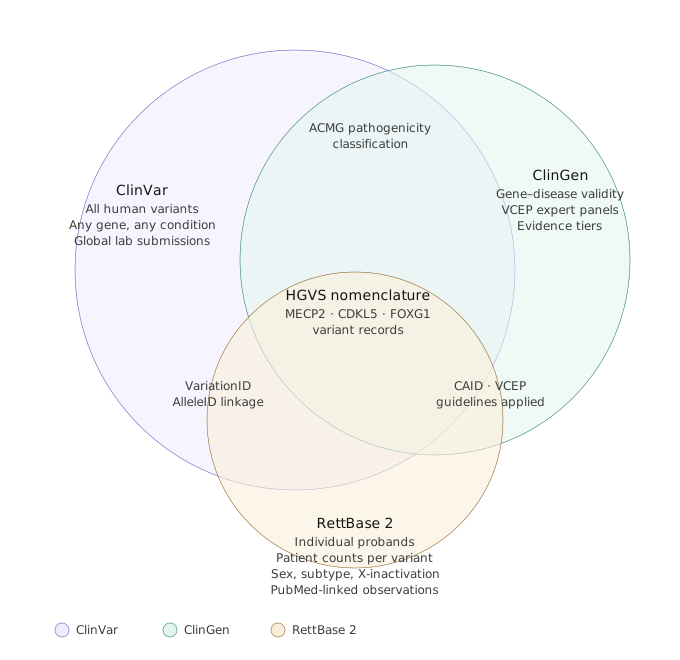
High Level Data Structure of RettBASE
Re-established in 2026, RettBASE is intended to align and cross-reference its genetic allele data with ClinVar and ClinGen by providing a platform where registered expert genetic professionals can upload and store information about probands (patients with Rett syndrome or related neurodevelopmental disorders carrying a documented variant).
In genetics, a proband is the specific individual through whom a genetic condition, family, or variant first comes to medical or research attention. The term is widely used in clinical genetics, variant databases, and pedigree analysis because it is more precise than simply saying “patient.”
A variant is represented as a canonical, HGVS-standardised allele anchored to a ClinGen Allele Registry identifier (CAID), which provides stable cross-referencing to ClinVar (via VariationID/AlleleID) and ClinGen's curated ACMG classification.
In Rettbase this means the variant table is the authoritative hub - carrying the gene (MECP2, CDKL5, FOXG1), HGVS nucleotide and protein nomenclature, ACMG pathogenicity classification, applied evidence codes, and links to relevant PubMed publications identified through systematic literature review.
Reference-Lists refer to PubMed publications and are modelled as a discrete related entity, enabling a many-to-many relationship between variants and their supporting evidence, with each publication traceable to one or more variant observations in the literature.
Probands are recorded as individual observations of a variant in a real patient, making them the key unit of measurement that distinguishes RettBase from ClinVar and ClinGen. ClinVar and ClinGen classify variants but do not track proband-level counts or clinical detail. Each proband record links to a variant, and carries clinical attributes including Rett subtype (classical, atypical, non-Rett), biological sex, inheritance/family carrier status, X-inactivation data, and the source publication or submitting institution.
This data structure allows RettBase to answer research questions that ClinVar cannot, such as how many independent probands carry a specific variant, what phenotypic spectrum is observed across those individuals, and how proband frequency correlates with pathogenicity classification.
Taken together, the relational model of variants → probands → observations → publications positions RettBase as a Rett-specific layer of clinical depth sitting on top of, and aligned with, the broader genomic standards infrastructure of ClinVar and ClinGen.